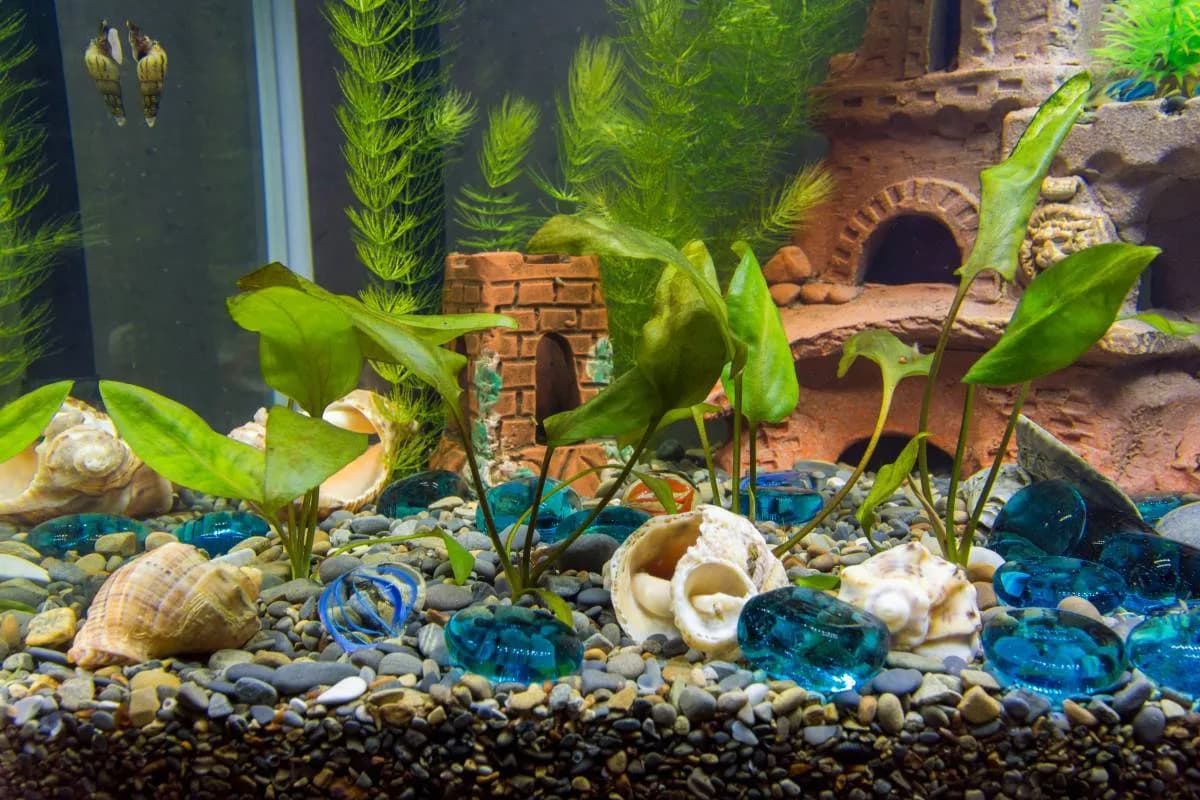
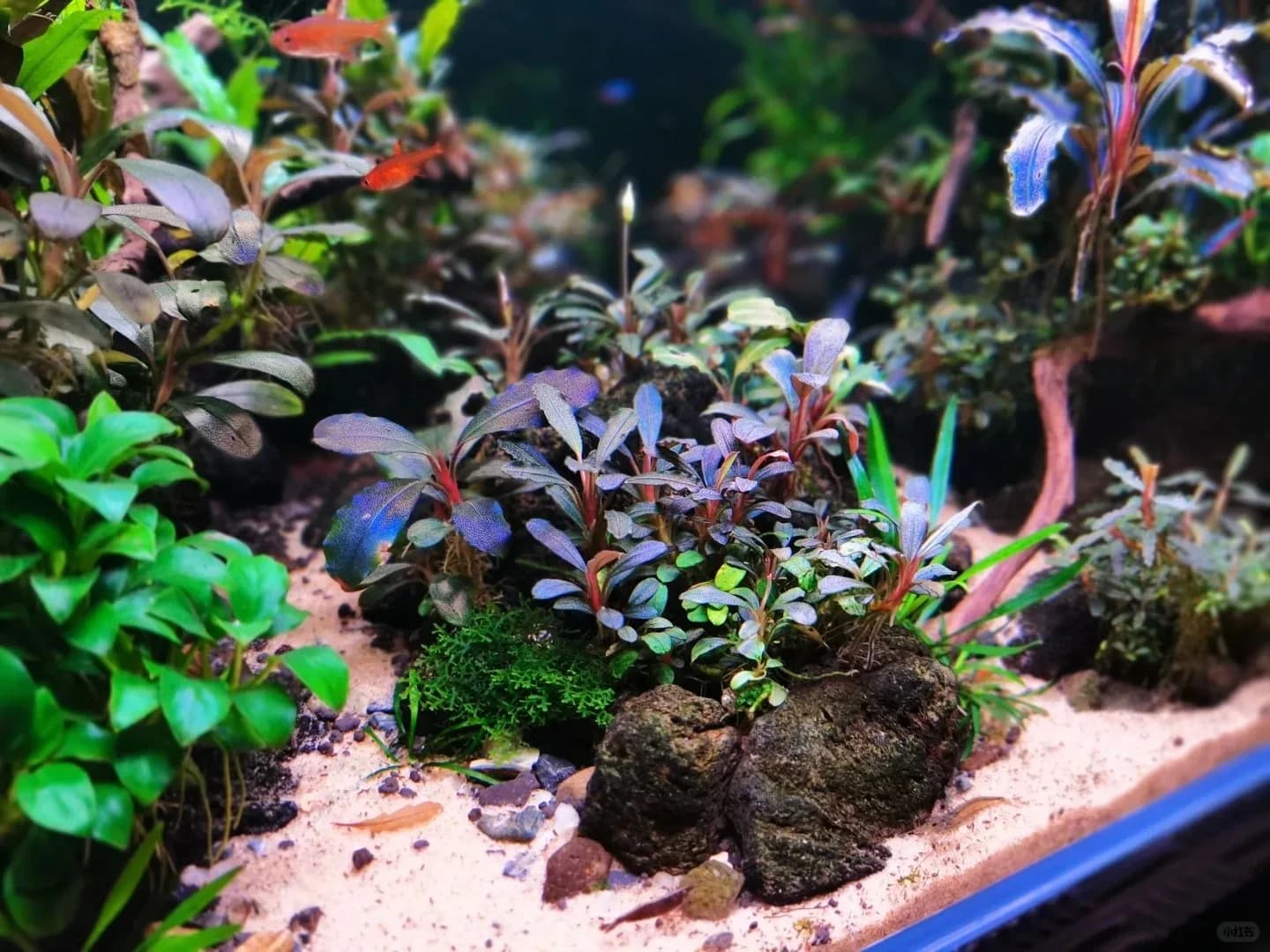
Desktop aquarium for office beginners: experience setting up a mini tank for Neon fish and Blue Dream Fire Red shrimp
Office desktop aquariums are becoming one of the choices that many aquarium enthusiasts in Vietnam are interested in, especially office workers who want a small relaxing corner rig
Office desktop aquariums are becoming one of the choices that many aquarium enthusiasts in Vietnam are interested in, especially office workers who want a small relaxing corner right on their work desk. A neat mini tank, with a school of Neon tetras constantly swimming along with a few dozen Blue Dream or Fire Red shrimp active all day, not only helps soften the rigid space but also creates a lively feeling and significantly reduces stress.
However, the reality of keeping a mini aquarium is not as "light" as many people think. The smaller the tank, the more prone water parameters are to fluctuations, the more susceptible fish and shrimp are to shock, and issues like planaria, shrimp loss, unstable water, or insufficient beneficial bacteria are more likely to occur. This is also why many newcomers to the aquatic and ornamental fish hobby often search for phrases like office desktop aquarium, mini aquarium setup for beginners, Mijia gen 2 aquarium, keeping Neon tetras in a small tank, or is keeping Blue Dream Fire Red shrimp difficult.
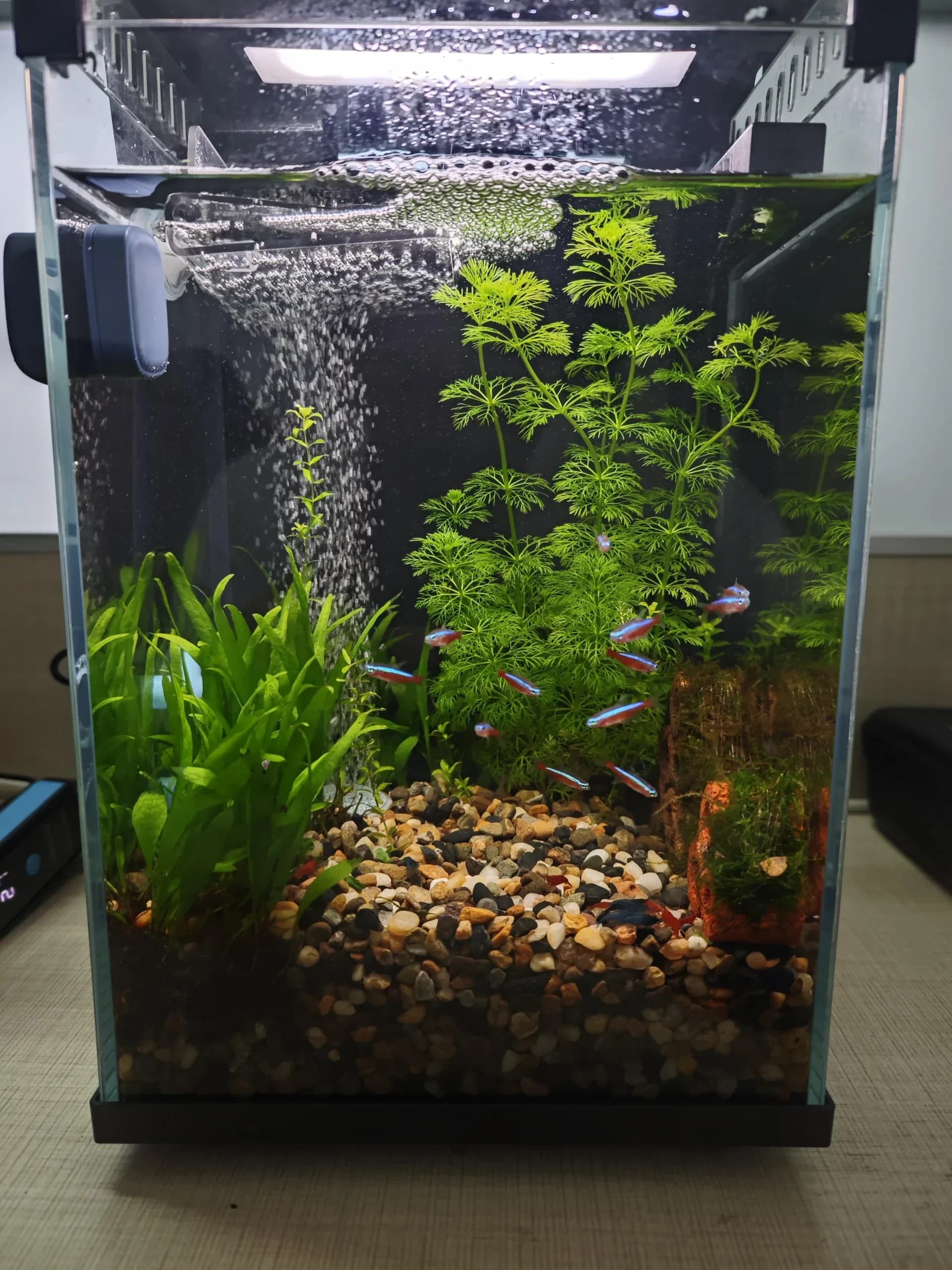
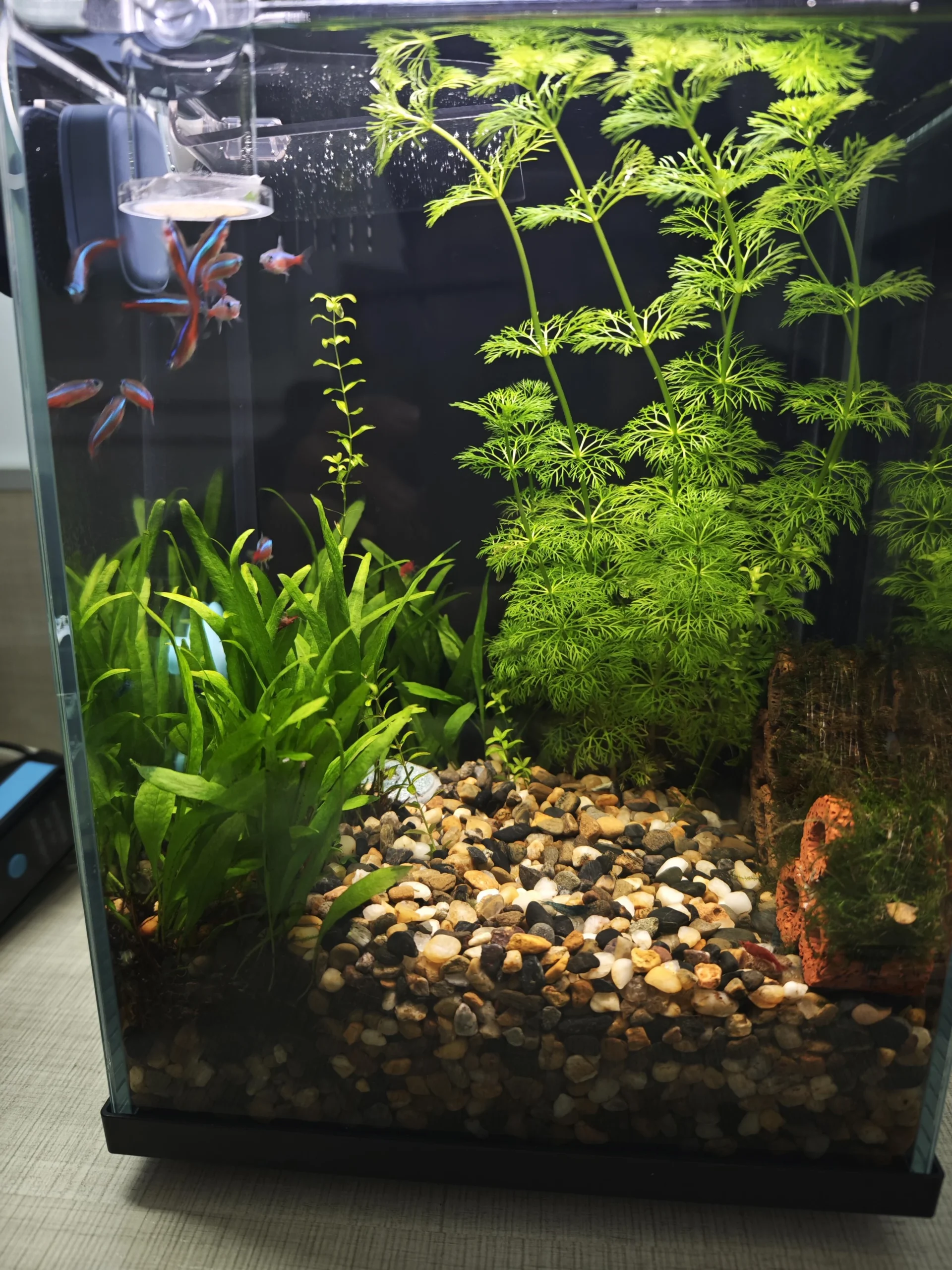
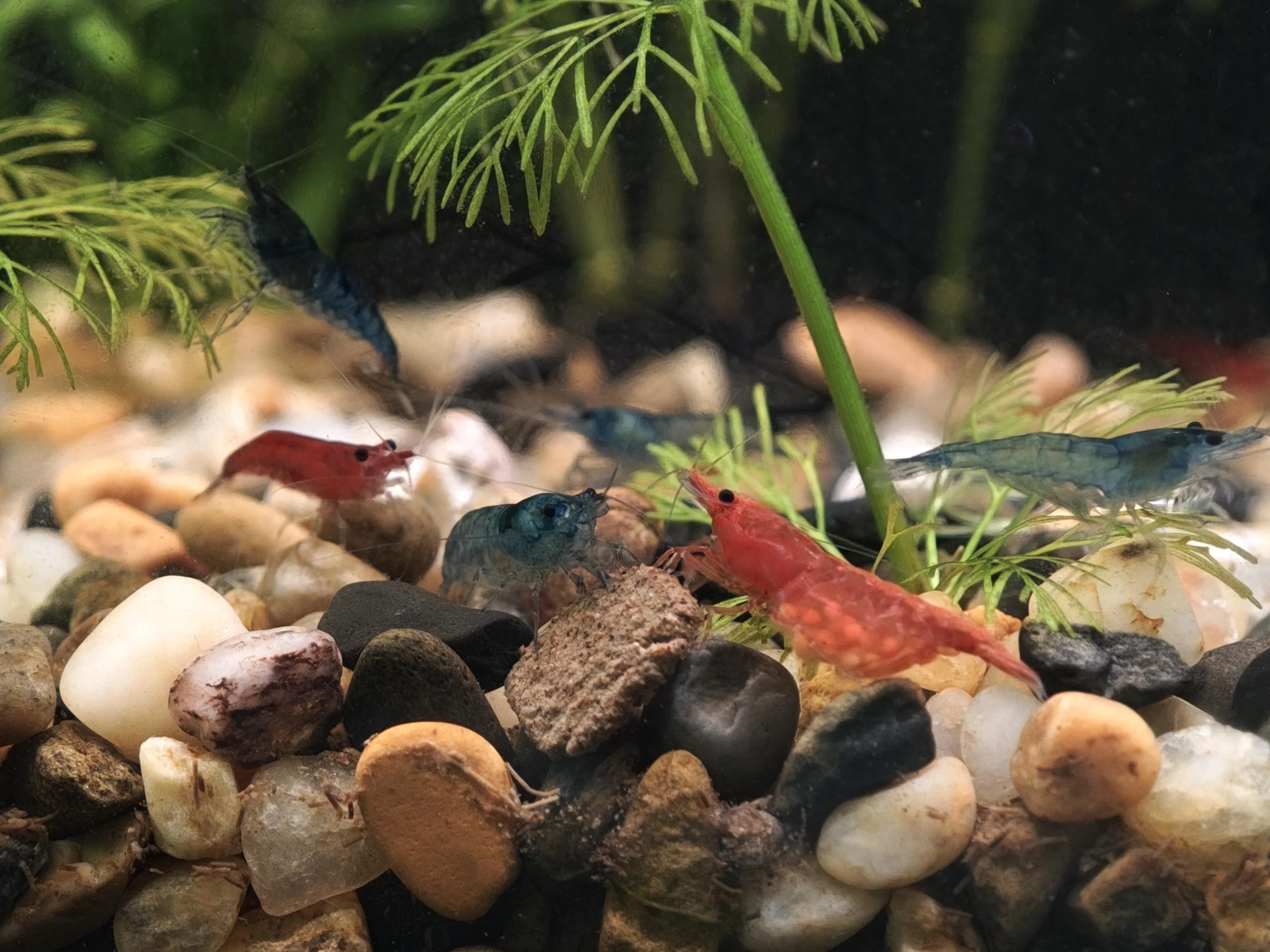
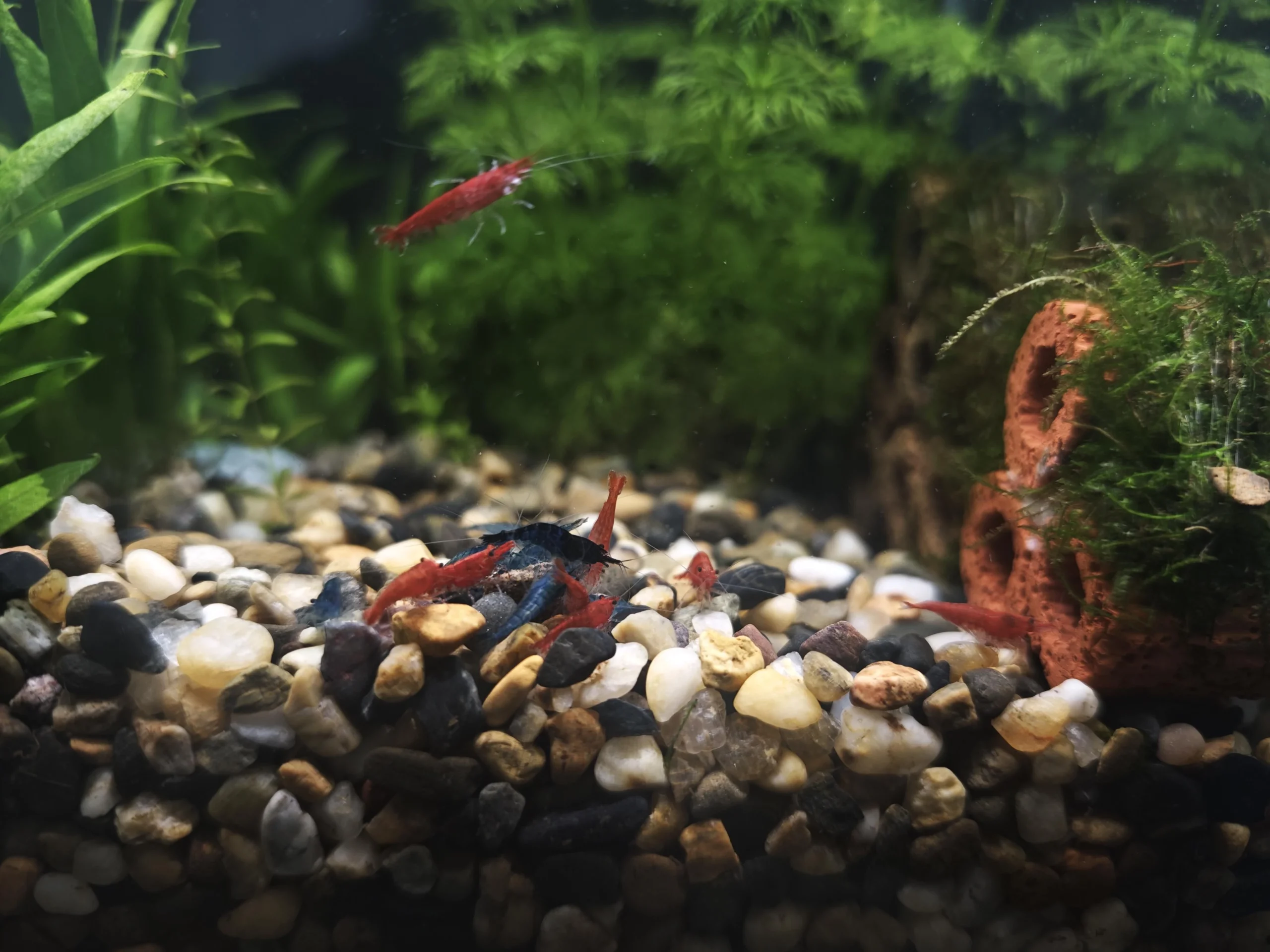
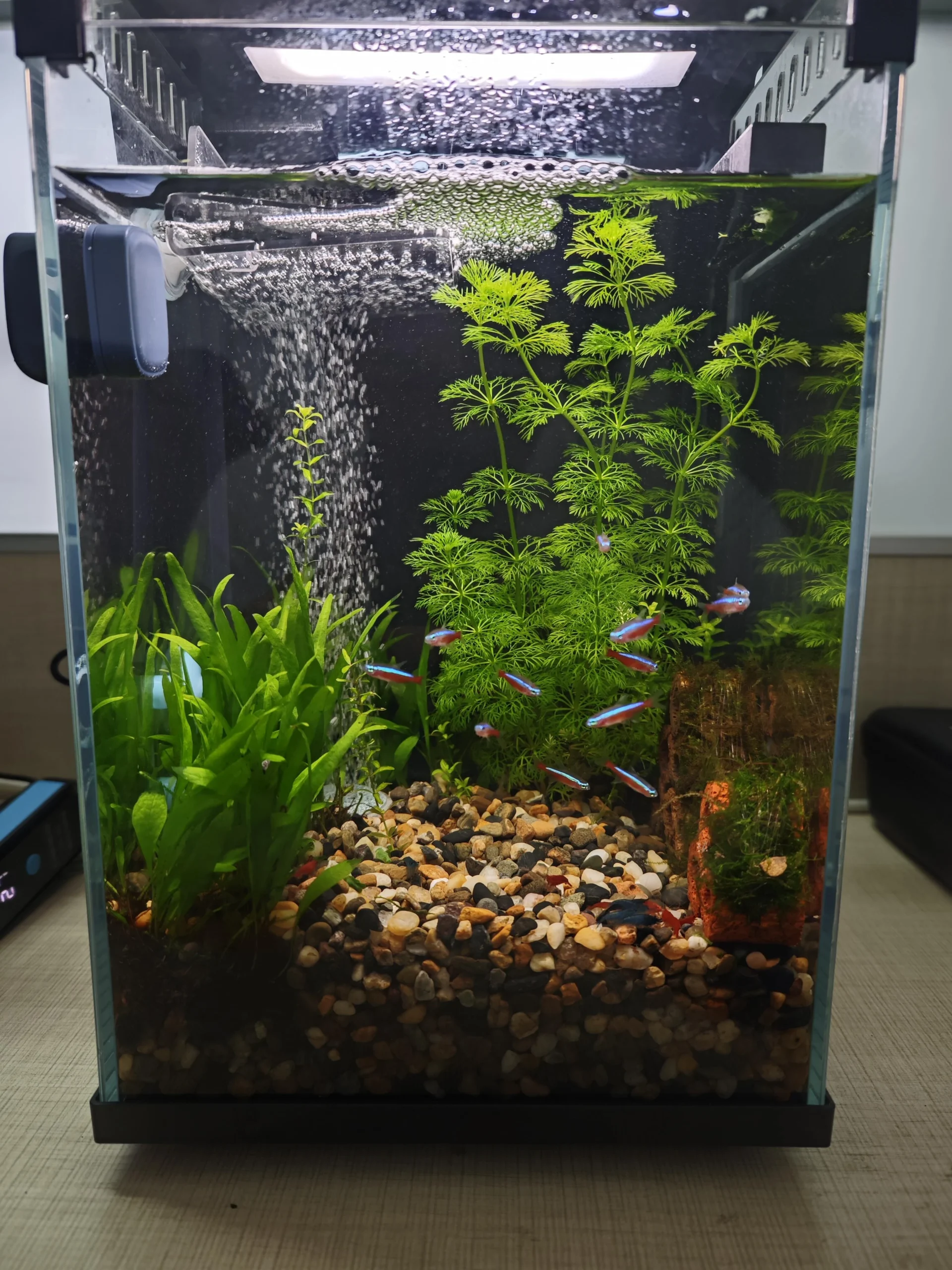
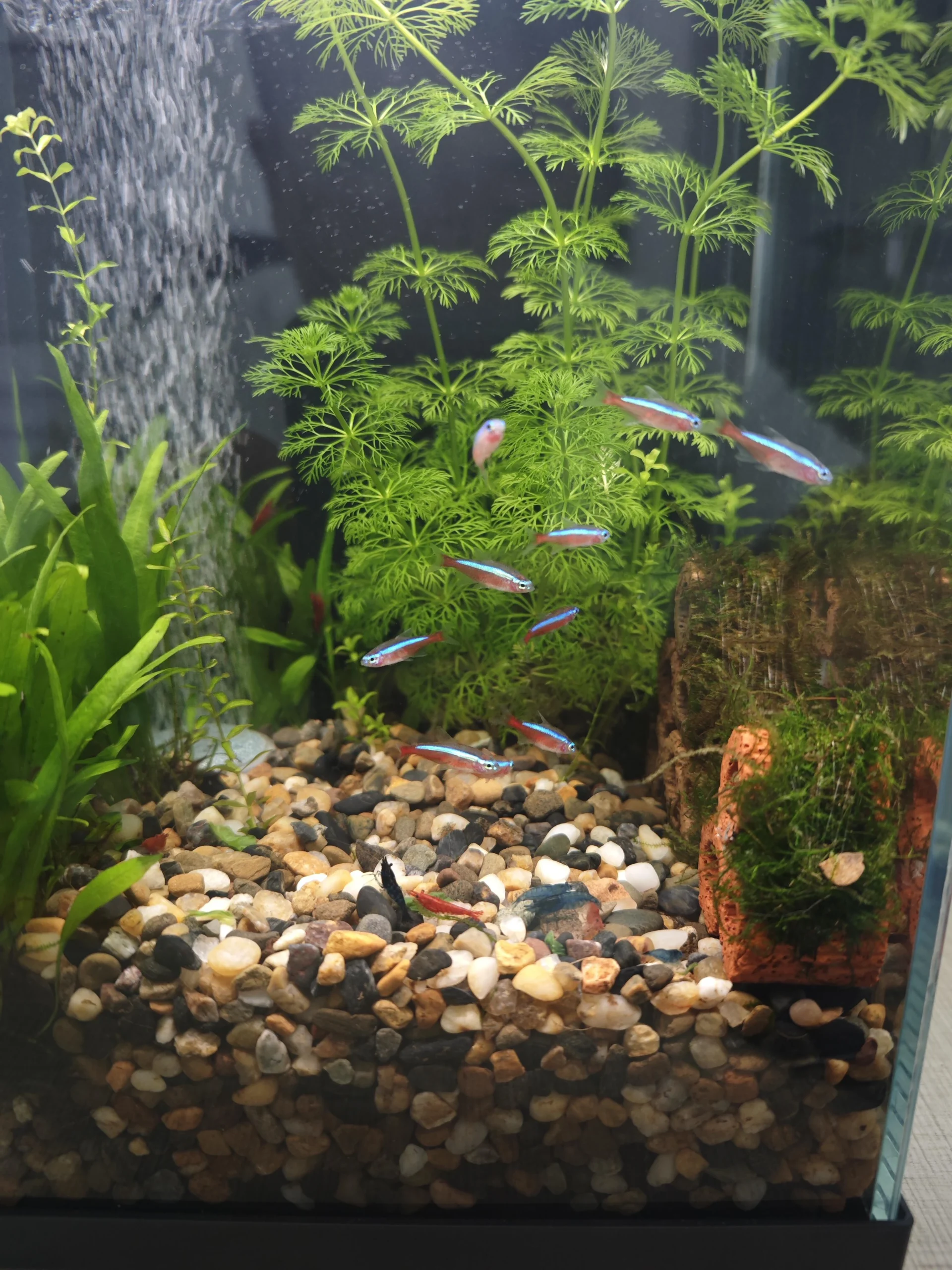
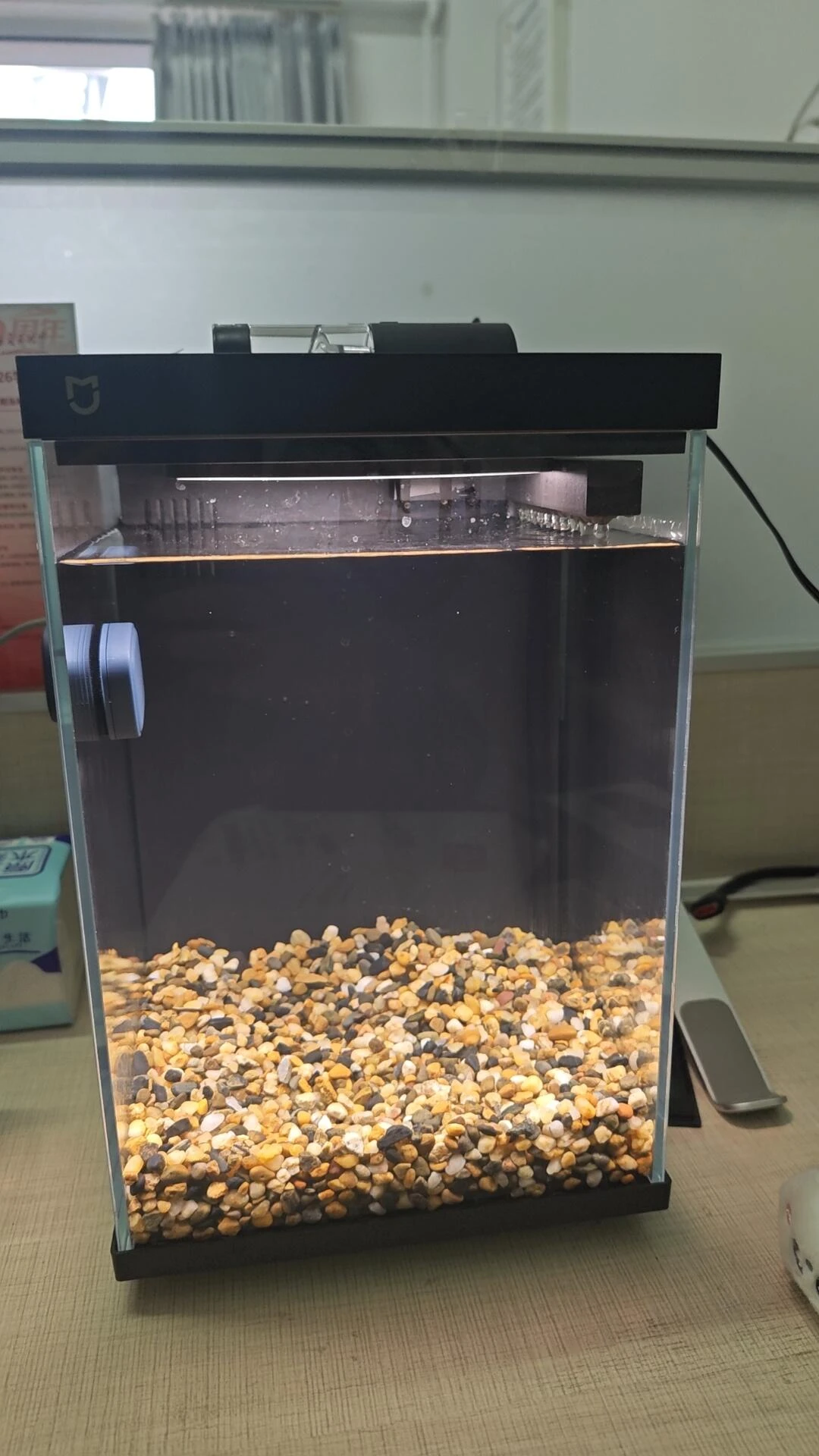
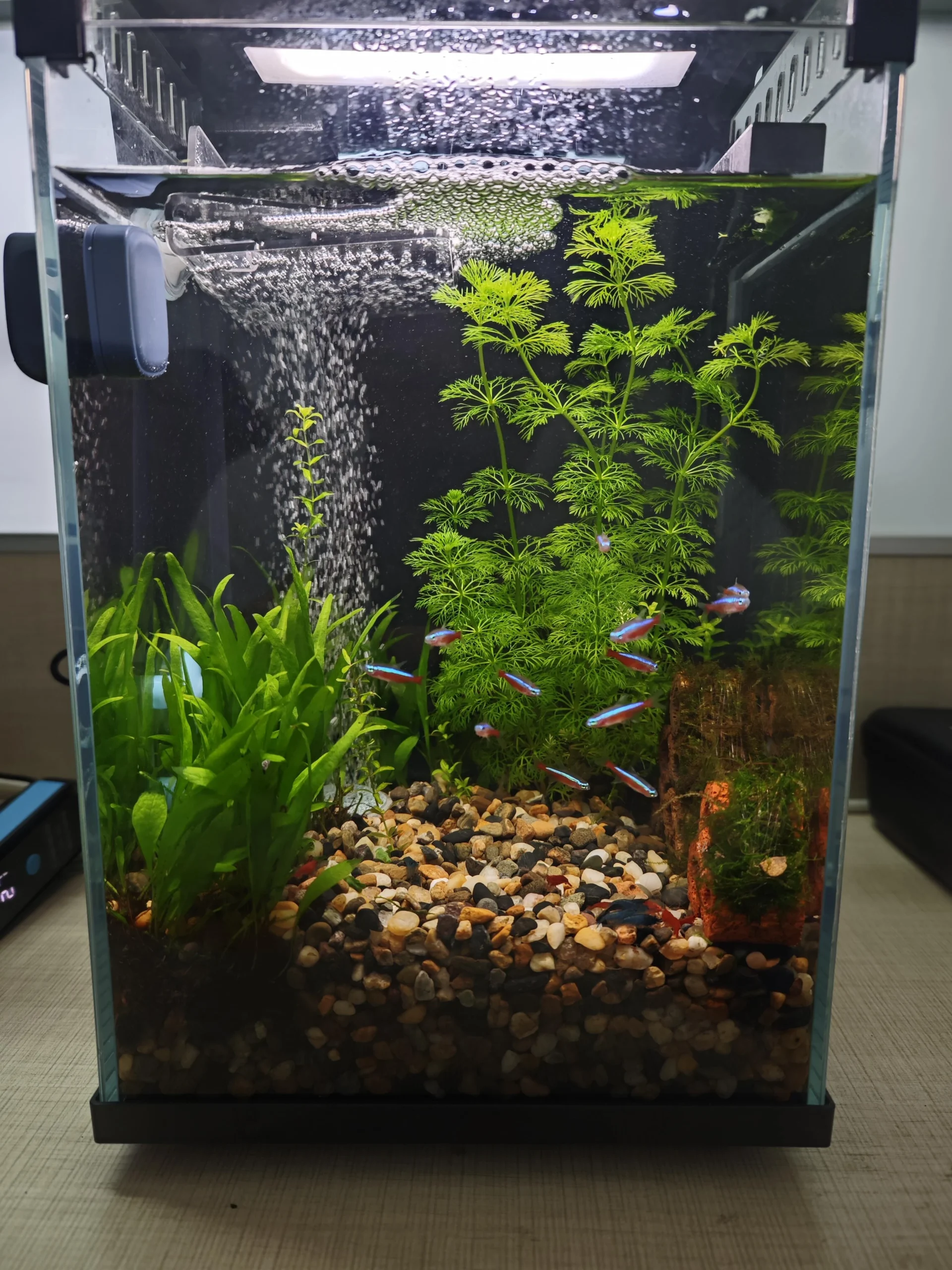
In this real case, the tank owner is a beginner, setting up an office desktop aquarium as their first tank. The inhabitants are quite attractive with 12 Neon tetras and 25 cleaning shrimp. Initially, 15 Blue Dream and 10 Fire Red shrimp were introduced. The tank is always bustling: some compete for food, some molt, some are carrying eggs. But alongside that fun are very typical problems for beginners: shrimp loss of about half, planaria appearing in the tank, having to dose Methylene Blue daily, supplementing beneficial bacteria, and regularly changing 1/3 of the water.
What makes this case valuable for SEO and practical value is that it accurately reflects the experience of many mini tank keepers in Vietnam. The total cost is about 1,132, where the cost of fish and shrimp is actually much lower than the cost of accessories. This is a truth that beginners often do not anticipate: keeping a mini tank is cheap on the livestock, but expensive on the equipment system and upgrades.
Office desktop aquarium for beginners: experience setting up a mini tank for Neon tetras and Blue Dream Fire Red shrimp
Related Posts
Comments
Why are office desktop aquariums attractive to beginners?
Office desktop aquariums have three major advantages. First is the small size, suitable for workspace. Second is that the initial cost seems not too high at a glance. Third is the excellent aesthetic effect: just a neat mini tank, a few rocks, some aquatic plants, a sufficiently large school of Neon tetras, and a few colorful shrimp can significantly uplift the mood of the desk corner.
Neon tetras are favored in mini setups because of their striking colors, peaceful temperament, beautiful schooling behavior, and when kept properly, they create a feeling that the tank has a "rhythm of life." Ornamental fish care sources all emphasize that Neon tetras are a schooling species, so they should be kept in a minimum of 6 or more, prefer stable tanks, clean water, low stress, and have plants or decorations for shelter.
Meanwhile, Blue Dream and Fire Red belong to the Neocaridina group, a popular ornamental shrimp line with beautiful colors, more accessible than many other high-end shrimp lines. They can adapt relatively well, but still need a biologically stable tank, water without strong fluctuations, and many surfaces for biofilm to develop. This is an extremely important point that mini tank keepers often overlook.
Analyzing the real case: why is a first tank both fun and prone to mistakes?
The interesting point of this tank is that the inhabitants are very suitable for the "entertainment mini tank" style: 12 Neon tetras create movement in the mid-level, 25 cleaning shrimp are responsible for the bottom and surfaces. Observing behaviors like competing for food, molting, and carrying eggs are signs that the tank has biological life, not just a display tank.
However, at least four major problems are occurring simultaneously.
1. The inhabitant density in the mini tank might be high for a beginner
A small tank keeping both a school of Neon tetras and a considerable number of shrimp will cause the biological load to increase quickly. For beginners, just an inaccurate feeding schedule, inconsistent water changes, or unstable beneficial bacteria can easily lead to organic waste buildup, followed by planaria and shrimp loss.
Office desktop aquarium for beginners: experience setting up a mini tank for Neon tetras and Blue Dream Fire Red shrimp
2. Shrimp loss is a sign that should not be taken lightly
Introducing 25 shrimp but losing about half is a signal to recheck the entire system. Common causes may include:
unstable water parameters
water changes causing TDS/temperature shock to shrimp
filter sucking up baby shrimp or weak shrimp
lack of hiding places
food competition
new tank lacking sufficient beneficial bacteria and biofilm
presence of planaria/flatworms or opportunistic predatory organisms
Neocaridina shrimp, though considered easier than many other lines, still develop best in a stable, established tank with a healthy beneficial bacteria system and consistent, gentle, regular water changes.
3. The appearance of planaria is a typical consequence of a tank with excess organic matter
Planaria in a tank is often related to leftover food, dirty substrate, a new tank being unbalanced, or being introduced from new plants, materials, or livestock. Some harmless flatworms can be mistaken for planaria, but true planaria usually have a slightly triangular head and are a concern in shrimp tanks, especially when baby shrimp or eggs are present.
4. Daily dosing of Methylene Blue in the main tank is a point that needs reconsideration
This is the most noteworthy part technically. Methylene Blue is typically used for situations like surface fungus, egg treatment, some protozoa, or support in quarantine tanks. Many specialized sources emphasize prioritizing its use in hospital/quarantine tanks rather than the main display tank, because the medication can affect the beneficial bacteria system, cause staining, and is not friendly to aquatic plants or invertebrates like shrimp if used incorrectly.
In other words, if the goal is to treat planaria in a shrimp tank, then daily dosing of Methylene Blue in the main tank is not the optimal direction for beginners to apply long-term. The core issue remains reducing organic matter, controlling feeding, correctly identifying harmful organisms, cleaning the substrate, increasing biological stability, and choosing a treatment method suitable for a shrimp tank.
Breaking down the setup cost of a mini aquarium: why are accessories the most expensive part?
Office desktop aquarium for beginners: experience setting up a mini tank for Neon tetras and Blue Dream Fire Red shrimp
The actual cost of this case is about 1,132, of which:
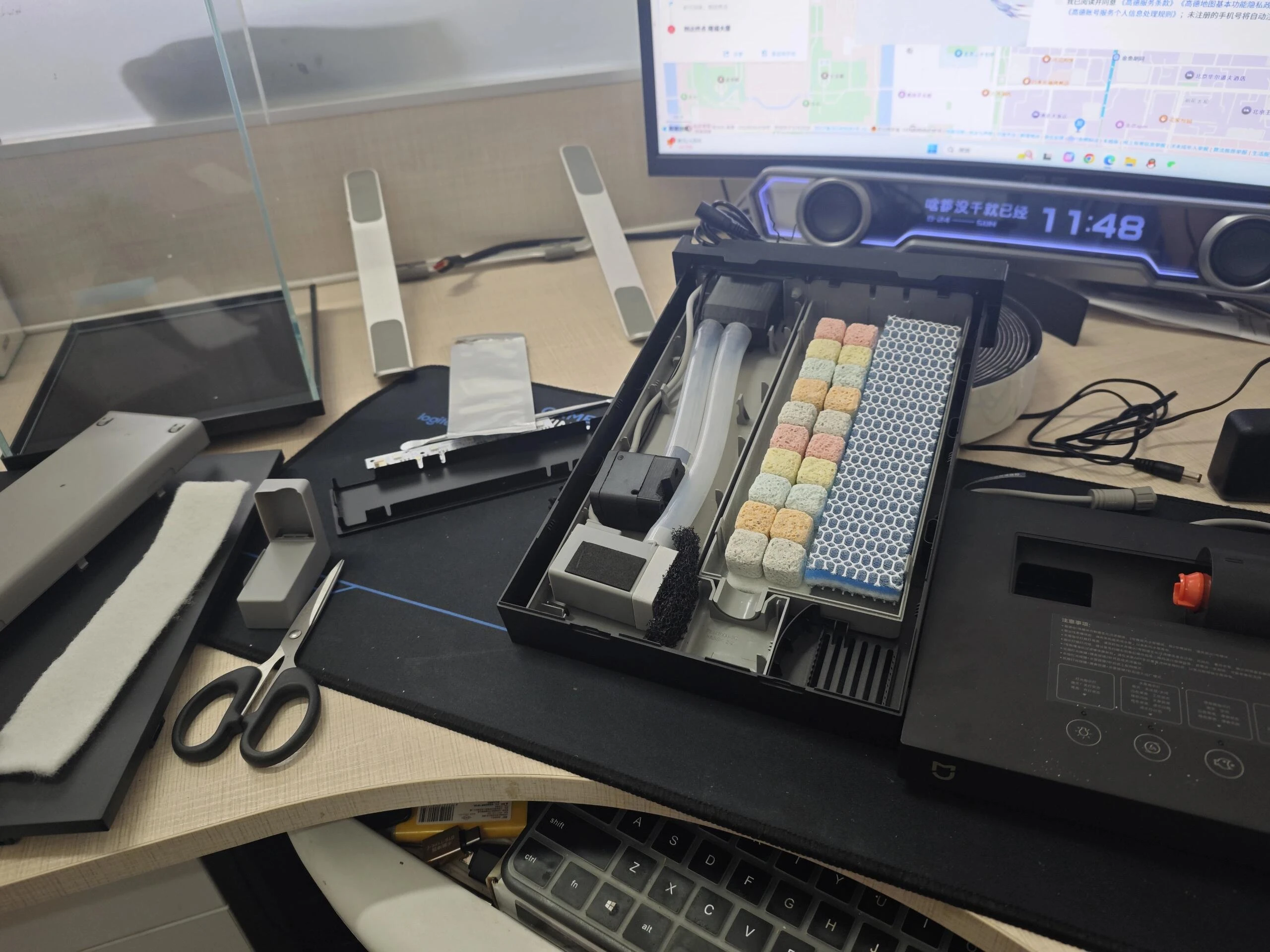
Mijia second-generation aquarium: 220
accessories: 860
shrimp cost: 19
fish cost: 33
This is a very typical cost structure in the mini tank hobby. Beginners often think fish and shrimp are the major expense, but in reality, the most expensive part is:
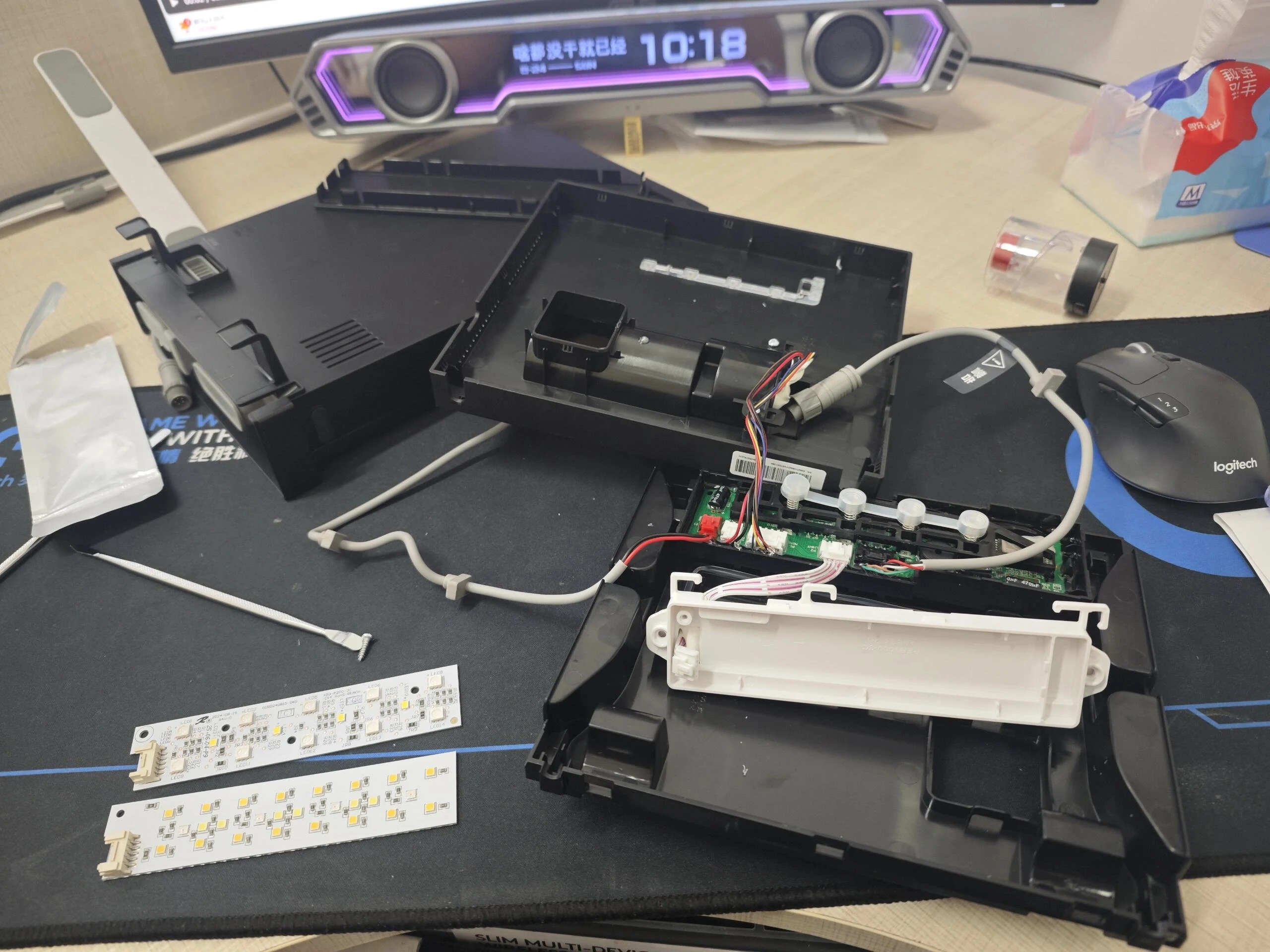
lighting
filter
heater
pump
substrate
fan
oxygen
water test kits
water treatment materials
maintenance tools like tweezers, brushes, gravel vacuums
Setting up an office desktop aquarium for beginners: how should it be optimized?
For a desktop mini tank to be truly stable, beginners should focus on four pillars.
Office desktop aquarium for beginners: experience setting up a mini tank for Neon tetras and Blue Dream Fire Red shrimp
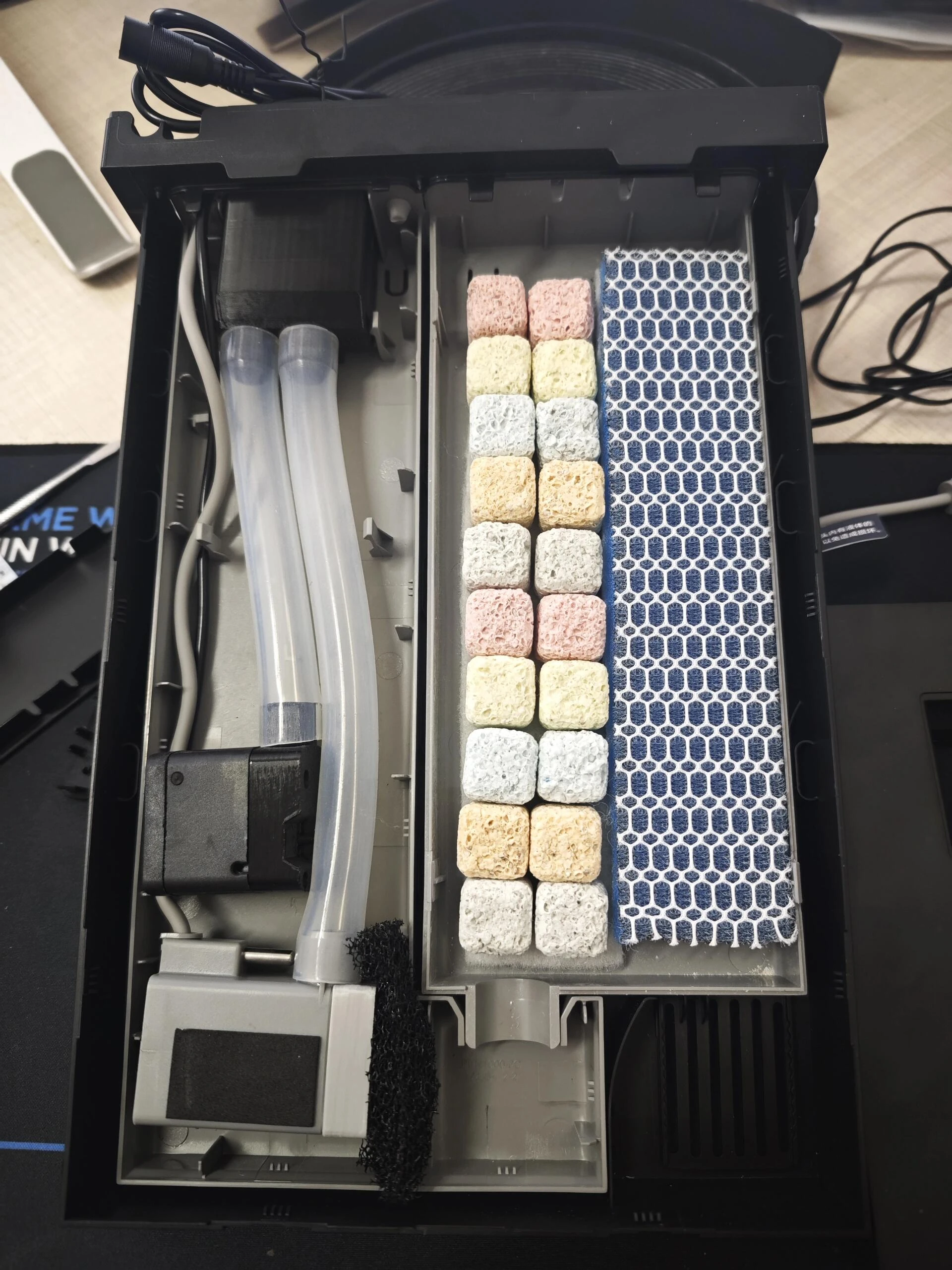
Filtration and oxygenation system
For a tank with shrimp, the filter needs to be safe for baby shrimp and not suck up small organisms. Shrimp care sources all recommend using a sponge filter or at least having a pre-filter on the intake to reduce the risk of sucking up baby shrimp and increase beneficial bacteria surface area.
Water stability
Neon tetras suit clean, stable water in a biologically established tank; Neocaridina shrimp also dislike strong parameter changes. This means that in a small tank, the keeper must be even more careful with water changes, medication dosing, mineral supplementation, and temperature adjustments.
Hiding places for shrimp
Shrimp carrying eggs, newly molted shrimp, or baby shrimp all need surfaces to cling to and places to hide. Moss, small-leaved aquatic plants, shelters, and materials that create biofilm all help increase survival rates. A tank with shrimp but too bare will be very difficult to stabilize long-term.
Feeding discipline
This is a point that seems small but has the strongest impact on whether the tank gets planaria or not. Excess food is a source of flatworm outbreaks, harmful bacteria, and waste. With a desktop tank, keepers tend to feed "for fun," especially when seeing the fish school compete for food is very pleasing to the eye. That is precisely the most basic mistake.
Treating planaria in a mini shrimp aquarium: the correct perspective for beginners
When seeing planaria in a tank, beginners often choose to treat immediately with medication. But the correct order should be:
Correctly identify if it is planaria
Not every worm in the tank is planaria. True planaria usually have a slightly triangular flat head, move by gliding, and are more concerning in shrimp tanks. Some types like rhabdocoela are much more harmless.
Reduce excess food source
This is a mandatory step. Without reducing food, even after using medication, recurrence is easy.
Vacuum substrate debris and perform controlled water changes
Proper water changes help reduce organic matter, but changing too much or inconsistently in temperature and minerals can shock shrimp.
Increase stability of the beneficial bacteria system
Shrimp tanks always benefit from a healthy biofilm and beneficial bacteria system. However, using medication incorrectly can weaken this system.
Limit overuse of Methylene Blue in the main tank
Sources about Methylene Blue describe this medication as a solution for specific situations, often leaning towards fungus, fish eggs, protozoa, or quarantine tanks; it is not the default choice for treating every problem in a mini shrimp tank with plants, beneficial bacteria, and invertebrates.
What mistakes should beginners of mini aquariums avoid?
Office desktop aquarium for beginners: experience setting up a mini tank for Neon tetras and Blue Dream Fire Red shrimp
Keeping too many inhabitants too early
First tanks are very prone to the mistake of "seeing the tank is still empty so adding more." But mini tanks do not have much margin for error.
Believing that a small tank is easier to care for than a large tank
Reality is often the opposite. Small tanks are beautiful, neat, take up less space, but are harder to keep stable than large tanks.
Changing water based on feeling
For shrimp tanks, what is scary is not just dirty water but also sudden changes.
Using medication without correctly identifying the problem
Planaria, fungus, bacteria, parasites, water shock, mineral deficiency… can manifest similarly. Using the wrong medication makes everything even more difficult.
Not investing in water testing and observing behavior
Water test strips, observing shrimp molting, fish coloration, breathing rhythm, feeding competition level, hiding frequency… are all extremely important signals for a mini tank.
Is the Mijia gen 2 aquarium suitable as an office desktop aquarium?
Office desktop aquarium for beginners: experience setting up a mini tank for Neon tetras and Blue Dream Fire Red shrimp
In terms of concept, yes. This is a type of tank very suitable for those who like neat, aesthetic setups, easy to place on a work desk or small corner. But for this type of tank to operate stably, the keeper needs to understand that:
a beautiful mini tank is not necessarily stable
the more mods, the more compatibility checks are needed
office desktop aquariums are affected by room temperature, air conditioning, lighting, care frequency, and work schedule
That is, for beginners, the Mijia gen 2 or similar mini tanks should be approached as a miniature ecosystem, not a decor item that just needs water to be complete.
Conclusion
From an experiential perspective, this is a very attractive office desktop aquarium: compact, lively, pleasing to the eye, truly embodying the spirit of 'keeping for relaxation'. However, viewed through a technical lens, this case also reveals nearly all the basic lessons for aquarium beginners: mini tanks are prone to fluctuations, Neon Tetras require a stable environment, Blue Dream and Fire Red shrimp, while easy to keep, cannot tolerate inconsistent care practices, and planaria are a sign of excess organic matter or some imbalance in the tank.
The most important thing is not to buy a lot more accessories, but to optimize three core elements: stable water, suitable filtration, and proper, consistent tank maintenance habits. When these three factors improve, a mini desktop tank can truly become a sustainable aquarium corner, not just a beautiful setup project for the first few days.